ECR4: PROJECT DEFENDER
ECR 4 (Version 4.1): 2.8 Powerstroke Install
UPDATE:
Sadly before the 2.8 could be installed in ECR4 we needed to move on to new projects and ECR4 was sold to a new owner. The new owner is keeping up the spirit of ECR4 and has taken it off road from Moab to Maine , just like we did. So we feel that ECR4 is in good hands.


It doesn't seem like years have gone by since ECR4 was reborn from the rusty NAS Defender 90 soft top donor that it was when we started on the project back in 1999, but time has a tendency of slipping away, and here we are 3 years of off road use and about 40,000 miles later.
As you may or may not know ECR4 is slated for a complete tear down to make some changes. These include a lot of things, the biggest being the install of a new Powerstroke 2.8 turbo diesel engine, but more on the changes later.
First, we wanted to go over a few things after 3 years of use as a daily driver, and off road rig, and fill you in on the good and the bad, The good news is that the 300 Tdi has been just an amazing powerplant. Over the last 3 years the only thing the engine has required outside of routine maintenance was a new serpentine belt. The old one worked fine, but "squeaked" a bit so we changed it. Other than that it has been oil and filter and a few valve adjustments and that is it. That surpasses the 1994 and 1997 V8 EFI D90s we have owned by about 700%.
What else went wrong over the long term? Here's a list:
-The left front Earl's stainless steel brake line burst after it rubbed on the tire. We field fixed that in Moab, Utah without issue. We found the problem when the D90 was stopped so it wasn't a big deal. We can't fault the line either because they aren't made to rub on tires.
-The Stage III Fox shocks have required 2 sets of spherical bushings over the last 3 years, but that isn't bad considering that ECR4 is driven in terrible Maine winters with salt and sand on the road. The shocks still work fine, but the cases sure have rusted up and they don't look that good anymore.
-We broke a windshield in Colorado, but we can't fault ECR4 for that... but we can fault the idiot in the Chevy that was in front of us driving in the ditch!
-The trailing arm bushings and an upper A arm link joint have been replaced once, but with the heavy off road use and also being a daily driver that is to be expected with the big lift and hardcore abuse.
-The first generation Underdrive wasn't that great (a little noisy) so it was swapped out for a generation 2 unit and that has cured all the problems. However the old unit was given to a guy who still uses it in his daily driver, so it wasn't a failure.
-The 90 obviously has had its share of scrapes, a few dents and numerous brush scratches, but paint, body and everything else are holding up great, as you can see form the photo above, take on 1/17/03.
That is about it for the bad news. Now for the good list:
Actually almost everything is good news. This Rover has been a true work horse from pulling, winching and pushing dead Rovers around the grounds of ECR, to trail guiding on numerous events and daily transportation including numerous road trips across country... everything works well together and shows no signs of slowing down.
-The 300 Tdi and the entire drive train (R380 5 speed, LT230 1.4 transfer case, Ashcroft 4.11s and ARB lockers) have all been great. No failures of any kind. Not even any leaks.
-The Super Swamper SSR 35x12.50s have been a real mind blower. ECR4 is still on the original set! They are going to be changed this time around, but they will be handed down to one of our mechanics who will continue to run them on his Rover. Amazing pieces of equipment, can't say enough good about them.
-The Ashcroft axles, CVs and all have also been flawless. No failures of any kind. We even pulled out the CV joints a few weeks back to inspect them and they look good as new. The rear 30 splines have also been bulletproof, no failures of any kind.
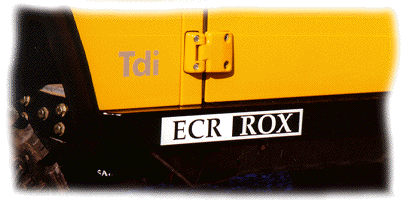
-The ECR ROX steering guards, sliders and such have all held up without issue, as has the Safari Gard 3 link and Stage III suspension.
ECR 4 has been an amazing rig, with the least down time of any Rover we know. We couldn't be happier.
WHAT CHANGES ARE IN STORE?
Although ECR4 was as well thought out as possible for the time when it was built, there are a few things that we want to change. These items certainly didn't fail, but after 3 years behind the wheel you learn what works for you and what doesn't. These changes will be as follows:
ENGINE:
The engine change to Powerstroke 2.8 isn't because we don't like the 300
Tdi. Quite the contrary, we love the engine, but as ECR4 was built to showcase
what could be done with a Defender 90 that would hit the trail hard, but
still be ready for daily use we need to experiment with the "latest
and greatest" to keep ECR4 on the edge, and somebody once told us,
"You can never have too much power." So it is out with the 195
ft lbs of torque, and in with the 277 ft lbs of torque.
INTERNAL ROLL CAGE:

Way back when, the goal of ECR4 was to be able to go from hard top to soft
top as easily as possible so a 4 point internal roll cage was constructed
to work with a hard top, soft top, no top, whatever. Well, it turns out
that with all the gear that the 90 carries and the weather here in New
England that the soft top change over just never came to be. The security,
reduced noise and warmer temps of the hard top have meant that the hard
top has been in place since it was installed. The problem with the internal
cage is that it does nothing to protect the outside of the 90 from trees
or other obstacles. If you've seen the roof damage on ECR4 up close you
know that more is needed to protect the upper section of the 90 from trail
abuse. Red arrows above show major tree hits. So to that end we are removing
the internal cage and installing a 6 point external cage. This will protect
the roof and allow for more aggressive uses off road even if a tree is
leaning into the trail line.
REAR TRAILING ARMS:

We can't tell you how many times that ECR4 would have easily made it up
some mind bending obstacle if it hadn't been for the rear trailing arm
pockets on the chassis. The chassis was modified to make these areas tough
as nails, so we didn't bend or break anything in this area, but it sure
as hell hangs down too far and acts like a "hook" or "anchor"
in a lot of situations. These pockets are history. We'll be installing
longer trailing arms mounted to the frame rail without the pockets to eliminate
the problem.

We get lots of calls regarding the Powerstroke 2.8. The first thing to realize is that this is not the 7.3 liter Powerstroke from the USA Ford F-Series trucks. That is a massive V8 diesel, and as much fun as that would be, it would wreck the rest of the drivetrain in a Defender with its 625+ ft lbs of torque. The 2.8 Powerstroke is an in line 4 turbo charged direct injection diesel, built by International in Brazil. It is used in numerous Ford products in South America. The block design is that of a 300 Tdi. The best way to think about the 2.8 Powerstroke is as a "hot rod" 300 Tdi, built by professionals. The 2.8 is the same in a lot of respects as its 2.5 liter 300 Tdi cousin, but vastly improved to have better cooling and more power at a lower rpm. 277 ft. lbs. at 1400 rpms vs the 300 Tdi that has 195 ft. lbs. at 1600 rpms. This means more grunt for off road uses, and more pulling power for better highway uses. Horsepower figures are also up. The Powerstroke 2.8 will fit where a 300 Tdi used to be, but if you are going from USA spec. V8 to 2.8, you'll need to go through all the same changes, like you were fitting a 300 Tdi, and actually a few more.
In the image above you can see the standard 2.8 as it is delivered. The abbreviated list of things you'll face to install the 2.8 where the 2.5 300 Tdi used to be are: air intake, exhaust, cooling system, oil system, engine rear cover, timing cover, motor mounts, fuel filter, Air Cond. brackets, etc. Sounds fun huh? Imagine if you were going from EFI V8 to 2.8... the list doubles.
In the image above you can also see that the 2.8 has a steel rear engine bracket, This needs to be removed and replaced with the 300 Tdi's alloy rear engine bracket and starter. (shown below) so that the engine can mate to the R380 Land Rover gearbox.

You can also notice that the injection pump sits at a different angle making a stock Air Cond. compressor mount useless. The oil filter is located at the back on the RH side vs. the 300 Tdis front mounted filter, and gone are the external oil lines for the radiator mounted oil cooler from the 300 Tdi. the 2.8 has a direct coolant to oil cooler mounted on the RH side of the block. This is a great addition and eliminates the chance of a broken oil cooler line side lining your Rover, as all the oil parts are now internal.

Here you can see the LH side of the 2.8 engine. Other changes in the 2.8 over the 2.5 300 Tdi include a belt driven vacuum pump for your brakes and other accessories and a stock 85 amp Bosche alternator. Engine mounts are also radically different as are the intercooler in and out locations.

In this image we've fitted the exhaust head pipe to the 2.8 temporarily so you can see the difference in the turbo set up. The massive variable turbo on the 2.8 has intake at the front and exhaust out the back.

The 300 Tdi has intake at the back (red plug) and exhaust out the bottom in it's waster gate turbo, so needless to say the new exhaust system will be custom made for ECR4, and boy doesn't that turbo seem small when you look at the 2.8's unit. Turbo envy anyone?

The top section of the 2.8 looks close to the 300 Tdi but some pretty radical things have been done inside the engine. To flow more air (more air equals more power) the head has been totally re-worked. The intake passages are larger, and smaller head bolts have been used to allow these passages in a few locations. The red arrow points to the smaller head bolts. The green arrow points out the turbo's fresh air intake. This points forward and is mounted high on the engine on the 2.8, unlike the rear facing 300 Tdi's turbo intake. The intercooled air intake is also moved to the RH side to allow for the turbo inlet.
Next up... gut ECR4 and start the work.
Stay tuned!